
News
N1 Insights: The iGaming Trends Everyone Will Be Talking About This March

In January, N1 Partners launched a new series featuring monthly iGaming market insights – and in March, the team continues to share practical analytics. Each month, N1 Partners’ iGaming affiliate marketing experts break down key changes across traffic sources, GEOs, content, technologies, regulation, and other areas, drawing on real data, campaign statistics, and the experience of the industry’s strongest players.
March shows that the market is окончательно moving out of its winter testing mode and shifting toward precise optimization and scaling. The focus is now on the efficiency of funnels, resilience to platform updates, and process technological maturity. Competition is intensifying, and decisions are becoming increasingly data-driven and strategic.
What is already changing – and what to prepare for in the coming month – we break down step by step.
Part 1: Traffic and Performance
1.1 Top trending traffic sources in March and upcoming tendencies
In terms of dynamics, Facebook remains the main driver, continuing to demonstrate the highest level of stability among traffic sources. TikTok and ASO periodically show strong results as well; however, these channels are characterized by high volatility and do not always provide a predictable traffic volume.
Speaking about SEO traffic, the following trends can be highlighted:
1. Ongoing content optimization in line with E-E-A-T principles. We are seeing cases where websites generate clicks but fail to convert traffic because Google does not perceive them as sufficiently useful or authoritative for users.
- A growing interest in the cross-brand approach. Such projects tend to adapt more easily to market and algorithm changes. We are also observing an increase in sports-related traffic driven by a packed events calendar in Q1 2026.
- In addition, there is a continued gradual cleanup of PBN websites from search results, along with a shift in focus from traditional link-building toward the development of high-quality content.
1.2 Brand requirements for traffic quality
More and more brands are revising their performance evaluation approach, shifting from a 3-4 month horizon to analyzing results within the current month. This significantly increases traffic quality requirements from the very start of cooperation.
No one expects 100% ROI in the first month; however, traffic must demonstrate positive dynamics and, most importantly, bring in active and “real” players. Early engagement metrics and audience quality indicators are becoming the key factors in decisions regarding scaling and further collaboration.
1.3 KPIs and traffic evaluation metrics
In the SEO traffic segment, the key metrics that determine further activity and potential caps are ROAS and Average Deposit Count. These indicators make it possible to assess not only the initial conversion but also the real value of the acquired player.
As for Facebook, PPC, ASO, and other traffic sources, the market is increasingly shifting its focus from volume to quality. Primary attention is given to the deposit-to-redeposit ratio, player LTV, and stream profitability in weeks two, three, and four. Monetization depth and behavioral metrics are becoming the decisive factors when it comes to scaling decisions and budget allocation.
1.4 Scaling approaches that will deliver the best results in March
Much still depends on the GEO and traffic source – there is no universal scenario. For PPC, maintaining volume remains the priority, while for Facebook, stable ROI becomes the key factor. The approach to performance evaluation is becoming increasingly differentiated depending on the acquisition channel.
From an SEO perspective, several consistent trends can be highlighted:
- Parasite SEO.
Across most of our key GEOs, we are seeing a sharp increase in new content published on high-authority platforms such as Trustpilot, Reddit, Yahoo, and other major domains. - SEO funnels with YouTube channels.
Despite some skepticism, this format delivers both volume and stream profitability. Video content strengthens trust and improves organic traffic conversion rates. - Niche review websites.
Large portals are entering narrow segments less frequently, while smaller players are successfully capturing rankings for highly specific keyword queries. These are often simple, strictly keyword-optimized one-page websites that nonetheless demonstrate strong performance. - Local keyword queries.
These perform especially well in smaller but high-income GEOs such as Denmark, Norway, Austria, and Switzerland. In these markets, a localized approach results in significantly higher conversion rates due to the audience’s strong purchasing power. - Cross-brand strategies.
However, they are effective only with strong coordination: a responsive affiliate manager on the webmaster’s side and a strong product manager on the brand’s side who can quickly assess traffic quality and provide prompt feedback on the funnel. Without fast communication, this model loses efficiency.
Part 2: GEO Priorities
2.1 Tier-1 GEOs with the highest growth potential in March
Across Facebook, PPC, and other paid traffic sources, several GEOs stand out with relatively small but high-quality audiences. Players demonstrate consistent activity and strong monetization, particularly in Austria and Germany. This remains a fairly traditional trend.
In terms of SEO, strong potential is currently emerging in Canada, Norway, Denmark, New Zealand, Ireland, and Slovenia. In these countries, parasite SEO is actively developing, cross-brand strategies are performing effectively, and new niche review websites are entering the market with well-structured content and carefully designed UX. Competition is gradually intensifying; however, due to the overall improvement in project quality, the potential for organic scaling remains high.
2.2 More challenging GEOs to enter in March
When it comes to SEO traffic, the situation across key Tier-1 markets remains stable: Germany, Australia, and Canada continue to be characterized by high competition and increased regulatory risks. In Europe, strict GDPR compliance requirements remain in force, where data handling mistakes can lead to significant fines.
Australia also enforces stringent requirements from local regulators. Under such conditions, SEO in these GEOs requires a cautious strategy, strong legal expertise, and heightened attention to compliance.
The situation with Facebook and PPC traffic looks different. The market has accumulated substantial expertise in Tier-1 regions, so Facebook traffic is likely to remain stable and continue performing effectively with proper ROI management.
At the same time, PPC in Tier-1 is becoming increasingly challenging: growing competition, stricter platform policies, and rising auction costs may make this year particularly demanding for partners who primarily rely on PPC traffic.
2.3 March regulatory changes impacting SEO strategies in Tier-1 GEOs
The trend toward stricter regulatory measures in Tier-1 markets will continue to gain momentum. Increased tax pressure and tighter deposit limits per player are already shaping a steady trend: part of the audience in Europe is gradually shifting toward “grey” operators. In turn, this is attracting new webmasters to these markets.
At the same time, tightening restrictions are significantly narrowing traditional funnels and limiting promotional opportunities in the conventional SEO sense. As a result, the market is increasingly moving toward hybrid models, where organic traffic is combined with Facebook, Telegram, social sources, and parasite SEO funnels.
Such diversification is no longer just a competitive advantage – it is becoming a necessity to maintain both traffic volume and quality amid growing regulatory pressure.
Part 3: SEO Content and Algorithms
3.1 How will the effectiveness of classic link building change?
There are already clear precedents showing a decline in the effectiveness of traditional link building. Previously, it was possible to purchase 100 backlinks, with 50 getting indexed and 10 actually ranking and delivering tangible results. Today, there is a high probability that all 100 links may bring little to no measurable impact.
Search engines are increasingly shifting their focus from external factors to the internal quality of a website. Priority is given to navigation usability, page load speed, well-structured content architecture, clear information formatting, and genuine user value. Under these conditions, a mechanical backlink growth strategy is losing effectiveness and requires a shift toward a more comprehensive approach focused on product quality and user experience.
3.2 Which SEO approaches will stop working as effectively as before?
- PBNs and mass purchasing of cheap backlinks are gradually losing relevance.
- A broad keyword set no longer guarantees high traffic volume.
- Long-form content created solely for volume is becoming ineffective.
- Generic, one-size-fits-all content is giving way to highly niche, specialized content.
Part 4: Economics, Costs, and ROI Forecasts
4.1 How will traffic costs change in March compared to the beginning of the year?
After the holiday period, the auction traditionally cools down slightly, making traffic costs more manageable. March is likely to become a favorable period for operations, with traffic available at more optimal prices.
At the same time, it is crucial to closely monitor global events, as auctions tend to react very sensitively to external factors. This can significantly impact both traffic costs and volumes.
4.2 Which factors will have the strongest impact on ROI in March?
For advertisers, the key factor remains player engagement with the product itself. The depth of interaction with the platform directly affects overall economics, retention, and long-term user value.
As a result, many advertisers are actively testing tailored approaches that focus less on acquisition volume and more on the quality of the product experience and the logic of the user flow. Optimizing onboarding, simplifying deposit processes, and strengthening retention strategies are becoming top development priorities.
4.3 How open will brands be in March to flexible deals for high-quality traffic?
This factor influences the market more strongly than it may seem. While overall traffic volume remains sufficient, truly high-quality traffic is becoming increasingly scarce. Under these conditions, partners are becoming more selective when choosing brands to work with.
Priority is given to products that demonstrate flexibility – those willing to negotiate individual terms, respond quickly to traffic quality feedback, and avoid imposing strict caps without objective reasons. Flexibility and openness to dialogue are becoming key competitive advantages in attracting and retaining strong webmasters.
4.4 How will the balance between traffic volume and margins change in March?
No significant changes are expected in March, as the market is likely to move toward stabilization. After active periods, market players tend to balance their performance metrics and establish more predictable unit economics.
There is still enough traffic volume in the market; however, the priority is shifting from quantity to quality. No one is willing to pay simply for traffic anymore – the key factors are efficiency, audience engagement, and actual profitability.
In conclusion, 2026 is likely to become a year of optimization and selection. Those who can quickly adapt to change, work closely with partners on the product side, and build strategies around real player value will be the ones who succeed. In a market saturated with volume, quality, transparency, and sustainable ROI are becoming the main competitive advantages.
The N1 Partners team of professionals understands the specifics of different traffic sources, GEOs, and cooperation models. That’s why we are ready to build flexible terms, respond quickly to market changes, and help our partners maintain stability even amid increasing pressure from regulators and platforms.
- 14+ casino and sportsbook brands with Reg2Dep up to 70%
- 10+ Tier-1 GEOs
- CPA up to €700 and RevShare up to 45% + NNCO for top partners + hybrid models
Be number one with N1!

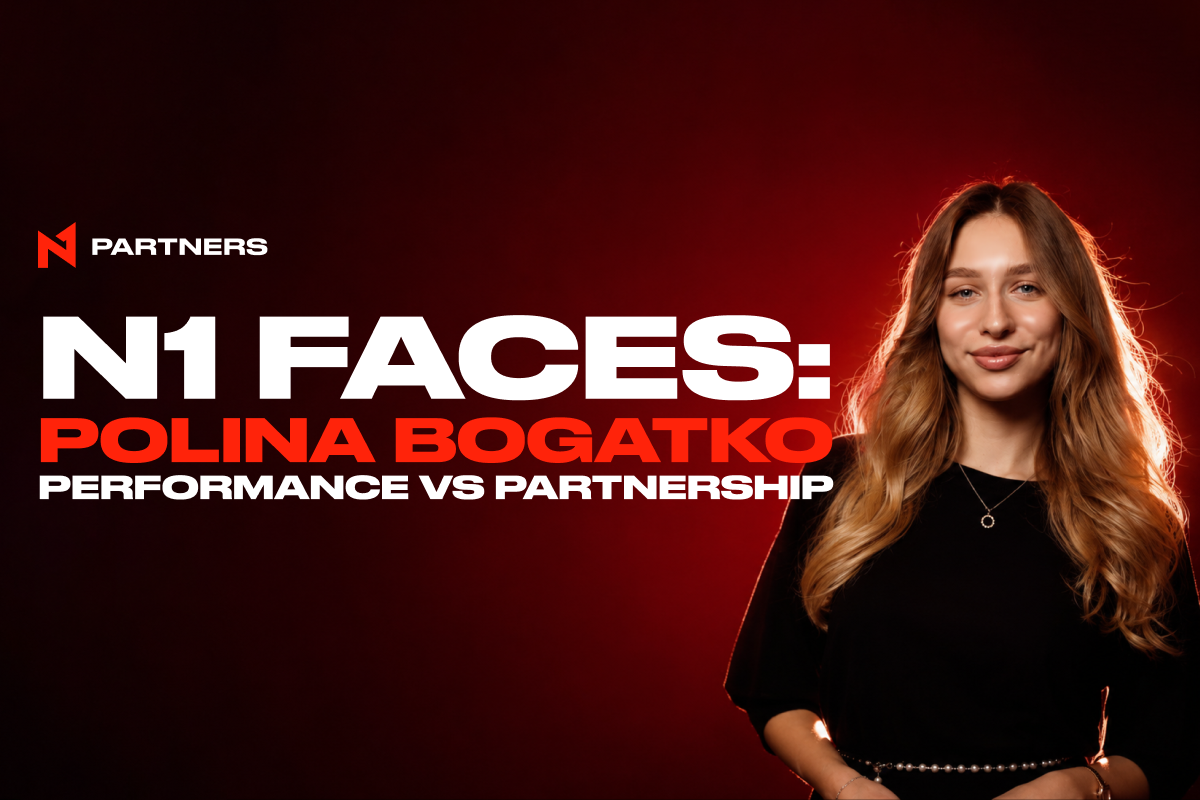
What matters more in affiliate marketing: performance or partnerships? At first glance, the answer seems obvious. But in reality, one rarely exists without the other. Sustainable growth is built on trust, transparent communication, and a shared commitment to moving forward together.
In this new edition of N1 Faces, Polina Bogatko, Affiliate Manager at N1 Partners, shares how she quickly found her place in the industry, why stress management remains one of the most underrated skills in affiliate marketing, and what truly separates a strong partnership from just good cooperation.
How did you get into affiliate marketing, and when did you realise this was the industry you wanted to grow in?
I entered affiliate marketing from an Account Manager position. It was a completely new industry for me, so I set myself an ambitious goal: to dive in as quickly as possible and understand how everything worked.
I spent a lot of time diving into industry content, watching interviews, talking to colleagues, and absorbing new knowledge every day. Within just a month, I had grown into the Affiliate Manager role.
That was the moment I realised I had found the right industry for me. I enjoy the combination of analytics and communication, the challenge of solving complex problems, and the opportunity to work with different people. I’ve also always loved starting from scratch and pushing myself beyond my comfort zone – those challenges are what keep me motivated.
What brought you to N1 Partners, and why did the opportunity seem so attractive?
I’ve always been drawn to companies where you’re not just completing tasks but continuously learning and growing. When the opportunity to join N1 Partners came up, I was immediately impressed by the strength of the team, the business scale, and the company’s reputation within the industry.
What stood out most was the culture. Initiative, expertise, and professional growth are genuinely valued here, and that’s exactly the kind of environment where I wanted to build a long-term career.
Looking back at the start of your career, what turned out to be completely different from your expectations? And what advice would you give yourself during your first month on the job?
At the beginning, I assumed affiliate marketing was all about moving fast and seeing results quickly if you worked hard enough.
In reality, every meaningful achievement is backed by consistent, systematic work. It takes time to fully understand a product, build trust with affiliates, and develop a real feel for the market.
If I could go back to my first month, I would tell myself one simple thing: don’t rush and don’t stress if everything doesn’t click immediately. Success in this industry isn’t about quick wins — it’s about consistency, patience, and showing up every day. The more comfortable you are with the learning process, the faster you’ll get where you want to be.
What changes in affiliate marketing do you consider the most significant over the past few years?
In iGaming, one of the biggest shifts has been the impact of AI on advertising platforms and on the way traffic moderation works
Facebook and Google have become much more precise in analysing user behaviour, creatives, and campaign setups, which has significantly affected both PPC and Facebook traffic acquisition.
A few years ago, scaling campaigns through proven approaches and rapid testing was relatively straightforward. Today, algorithms identify risky patterns much faster, accounts face stricter restrictions, and moderation standards continue to tighten.
As a result, traffic acquisition has become more expensive, while finding stable, scalable campaign setups requires far more resources and expertise.
On one hand, this has made life more challenging for affiliates. On the other hand, the industry has become more mature and professional. Today, the biggest winners are those who can analyse data deeply, test hypotheses methodically, and build long-term strategies rather than simply chasing volume.
What separates a truly strong partnership from simply good cooperation?
A strong affiliate partnership isn’t just about everything running smoothly. It’s about both sides being genuinely invested in achieving a shared outcome.
A great affiliate manager doesn’t simply reply to messages — they understand what’s happening with the traffic, identify growth opportunities, and help solve challenges when they arise. At the same time, successful affiliates don’t jump between offers every few days; they give campaigns enough time to optimise and reach their full potential.
Trust, commitment, and ongoing collaboration are the foundations of any lasting partnership.
Has there been a person, case study, or experience that significantly influenced the way you work with partners?
For me, that person was my first team lead, Vlad Chernov, Deputy Head of Affiliates.
He laid the foundation for how I approach affiliate management today.
One of the most valuable lessons he taught me was to evaluate traffic objectively, without emotions or bias, and rely on data and logic instead.
His communication style also had a huge impact on me. He always emphasised providing structured, actionable feedback rather than opinions or gut feelings.
Most importantly, he taught me not to be influenced by promises or pressure and to stay focused on actual performance.
What do you consider the most underrated part of an affiliate manager’s job?
Stress management. From the outside, the role may seem like a combination of chats and calls, but in reality, you’re constantly balancing the interests of partners, products, and internal performance expectations.
The industry moves incredibly fast, and maintaining a clear head during periods of pressure or fluctuating KPIs is essential.
This is one of those professions where long-term success depends not only on knowledge and experience but also on your ability to stay mentally resilient.
What mistakes most often prevent long-term relationships from developing?
One of the most common mistakes is avoiding difficult conversations.
Instead of discussing challenges openly and finding solutions together, people often stay silent with frustration building over time.
In long-term partnerships, that’s especially dangerous. Any uncertainty or lack of transparency quickly turns into distrust.
It’s always more effective to address issues openly, even when the conversation is uncomfortable, and work toward a solution together.
What helps you stay energised and avoid burnout in an industry that changes every single day?
Energetic affiliates give me a lot of motivation.
There are partners I regularly speak with through calls and chats, and those conversations are always dynamic and engaging.
We can laugh about industry situations, get frustrated by market challenges together, and then switch straight into problem-solving mode.
That combination of genuine human connection and shared focus on results helps me maintain momentum and avoid burnout.
If you had to describe your job in affiliate marketing without using the words “traffic”, “affiliate”, or “conversion”, what would you say?
I’d say it’s about turning chaos into a structured system. You communicate, analyze behavior, test different approaches, and identify what drives results.
It’s a mix of fast decision-making, constant interaction, and the ongoing belief that every process can be improved by optimizing the right details.
If you weren’t in iGaming…?
I would probably move into events or project management. I enjoy fast-paced environments where you have to bring people, tasks, and deadlines together into a system that works. Events offer excitement and constant decision-making in real time, while project management provides more structure and process control — but both come with the same sense of ownership and responsibility for the final outcome. What attracts me in both fields is the combination of organization, accountability, and measurable results.
TOP-3
Which qualities do you value most in partners?
- Deep expertise
- Flexibility
- Responsiveness
Which skills are most important for an Affiliate Manager today?
- Analytical thinking
- Ability to adapt to new rules and changing conditions
- Negotiation skills
Which tools or habits can you not imagine your workday without?
- A calculator 🙂
- My personal Telegram notes chat where I keep everything important
- Affiliate launch pings!
Blitz
New affiliate or growing with an existing one?
Growing and scaling existing partnerships.
Intuition or analytics?
Analytics.
Calls or messages?
Messages every day, calls once a week.
High volume or predictable results?
High volume with controlled quality.
Cooperate with N1 Partners!
For affiliates who value transparent communication, long-term collaboration, and hands-on support, strong partnerships start with a team that is genuinely invested in your growth.
Whether you’re looking for new scaling opportunities, tailored commercial terms, or a high-converting offer to test, Polina would be happy to discuss a potential partnership.
N1 Partners is a multi-brand affiliate platform and direct advertiser that brings together more than 14 casino and sportsbook brands. The company operates across Tier-1 markets and offers competitive commercial terms, including CPA payouts of up to €700 and RevShare of up to 55%.
With more than 14,000 affiliates worldwide, N1 Partners is trusted for its transparency, flexibility, and partnership-first approach. Long-term relationships, quality communication, and a shared focus on performance remain at the core of cooperating with the company.

N1 Partners is launching N1 Sport Promo, a promo campaign for affiliates driving Sports Betting and Prediction Markets traffic.
The promotion covers the biggest sporting and esports events of the season, including the FIFA World Cup 2026, Wimbledon, Formula 1, UFC Freedom 250, and many other major events. The promo runs from June 10 to July 20, 2026.
During the campaign, affiliates can increase their CPA payouts based on the volume of qualified FTDs they deliver. The more quality players a partner brings, the higher his rate and total earnings become.
Why join N1 Sport Promo?
Every major sporting event attracts new audiences to the betting vertical, and summer 2026 offers multiple powerful growth drivers for affiliates.
- Peak sports season.
The biggest sporting events of the year are perfect for scaling traffic and testing new funnels. - Growing payouts.
The more FTDs you generate, the higher your active CPA rate becomes. - Tier-1 GEOs.
The promo is available across Tier-1 markets with high potential and quality sports traffic.
N1 Partners team has compiled a guide covering key sporting events, June promotions, and expert recommendations for monetising Tier-1 sports traffic to help affiliates prepare for the upcoming sports season.
How does N1 Sport Promo work?
The mechanics are simple: the more quality FTDs an affiliate generates, the higher their CPA rate becomes.
SEO and PPC
Affiliates working with SEO and PPC traffic can increase their CPA rate with no limits.
Every 10 FTDs add an extra €50 to your current rate. There is no cap on CPA growth.
Example:
| FTD | Rate | Revenue |
| 1–10 | €300 | €3 000 |
| 11–20 | €350 | €3 500 |
| 21–30 | €400 | €4 000 |
| 31–40 | €450 | €4 500 |
FB, In-App, UAC, ASO, Email and SMS
A separate payout structure applies to affiliates working with Facebook, In-App, UAC, ASO, Email, and SMS traffic.
Every 30 FTDs increase your current CPA rate by €10. The maximum increase is €100 on top of the base rate.
Accordingly, the more successfully a campaign scales, the higher the final payout becomes.
Example:
| FTD | Rate | Revenue |
| 1–30 | €100 | €3 000 |
| 31–60 | €110 | €3 300 |
| 61–90 | €120 | €3 600 |
| 91–120 | €130 | €3 900 |
N1 Sport Promo terms
Registered N1 Partners affiliates are eligible to participate in N1 Sport Promo. Please contact your affiliate manager to join the promotion.
Not working with N1 Partners yet? Get in touch with the LeadGen team and join the promotion during the biggest sports period of the summer.
Main terms:
- Sports betting and Prediction Markets traffic is allowed.
- GEOs: Tier-1 (the list of available countries is provided by your manager).
- CAP: 50 FTDs at campaign launch.
- At least 60% of acquired players must place sports bets.
- Traffic to crash games must not exceed 30% of total volume.
- Incentivised traffic, fraud, and non-target GEOs are not eligible for the promotion.
- N1 Partners reserves the right to recalculate or cancel FTDs in cases of fraudulent activity or violations of the promotion terms.
- Payouts are processed according to the company’s standard payment schedule.
Detailed participation terms are available via the link.
Join N1 Sport Promo and turn the 2026 sports season into record-breaking results!
Join N1 Partners:
- 14+ casino and sportsbook brands with high Reg2Dep
- 10+ Tier-1 GEOs
- CPA up to €700 and RevShare up to 55% + NNCO for top partners
Be number one with N1!

N1 Partners has been shortlisted for the G Gate Awards 2026 in three categories. Following the first round of voting, N1 Partners remains in the race for victory in the following nominations:
- iGaming Advertiser of the Year
- PR Campaign of the Year
- Event of the Year
Reaching the final stage of the G Gate Awards 2026 reflects N1 Partners’ key achievements over the past year, including the growth of its affiliate program and product portfolio, the launch of the N1 Puzzle Promo with a €500,000 prize pool, and the organisation of the “Because We Can” Grand Final during iGB Affiliate Barcelona.
The second and final voting round is now open and will run until June 22. The winners of the awards will be determined at this stage, and every vote counts.
How to Vote for N1 Partners
Supporting N1 Partners in the final round takes just a few clicks:
- Visit the G Gate Awards website.
- Select N1 Partners in the following categories:
- iGaming Advertiser of the Year
- PR Campaign of the Year
- Event of the Year
- Click the “Vote” button.
- Enter your phone number.
- Confirm your vote via the incoming call or Telegram verification code.
Support N1 Partners at the G Gate Awards!
Each of these nominations reflects the work of the N1 Partners team, the trust of our partners, and the support of a community that continues to grow alongside the company.
There is not much time left until the final voting stage closes.
Your vote is very important — thank you for the support!
Why work with N1 Partners:
- 14+ casino and sportsbook brands with high Reg2Dep
- 10+ Tier-1 GEOs
- CPA up to €700 and RevShare up to 55% + NNCO for top partners
Be number one with N1!


N1 Faces Polina Bogatko — Performance vs Partnership
What matters more in affiliate marketing: performance or partnerships? At first glance, the answer seems obvious. But in reality, one...


Game On N1 Sport Promo Is Live
N1 Partners is launching N1 Sport Promo, a promo campaign for affiliates driving Sports Betting and Prediction Markets traffic. The...


N1 Partners in Three G Gate Awards Nominations
N1 Partners has been shortlisted for the G Gate Awards 2026 in three categories. Following the first round of voting,...


N1 Partners x RAZE Case: ROI+ in Canada within 3 Days
Gambling traffic in Tier-1 markets rarely forgives mistakes. Especially when it comes to Facebook, where CPM costs are high, auction...


Where to Drive Tier-1 Sport Traffic in June World Cup & N1 Sport Promo
June offers one of the biggest traffic opportunities of 2026. The start of the FIFA World Cup, combined with the...


N1 Brand Series: RollXO — Brand Breakdown & Traffic Setups
Picked a brand but not sure how to turn your traffic into profit? Looking for really working bundles? Want to...


ReferOn Shortlisted for Two EGR B2B Awards 2026 Following Record Platform Growth
ReferOn, the data-driven affiliate management platform, has been shortlisted in two categories at the EGR B2B Awards 2026: “Affiliate Software...


N1 Sport Promo Starts Soon: More FTDs, Higher Rates
N1 Partners is preparing a new promo for its partners, N1 Sport Promo, for the hot summer sports calendar and...


N1 Insights How to Leverage iGaming Trends This June
June is one of the most volatile months for iGaming: major sporting events overheat auctions, competition for high-quality traffic intensifies,...


MAC 2026 Recap N1 Partners Win at MAC Awards
MAC 2026 has become one of the key affiliate events for N1 Partners this spring. The team attended one of...
-

 News2 weeks ago
N1 Insights How to Leverage iGaming Trends This June
-
News2 weeks ago
N1 Brand Series: RollXO — Brand Breakdown & Traffic Setups
-
News2 weeks ago
N1 Sport Promo Starts Soon: More FTDs, Higher Rates
-
Affiliate Success2 weeks ago
ReferOn Shortlisted for Two EGR B2B Awards 2026 Following Record Platform Growth
-
News7 days ago
Where to Drive Tier-1 Sport Traffic in June World Cup & N1 Sport Promo
-
News6 days ago
N1 Partners in Three G Gate Awards Nominations
-
News4 days ago
Game On N1 Sport Promo Is Live
-
News6 days ago
N1 Partners x RAZE Case: ROI+ in Canada within 3 Days